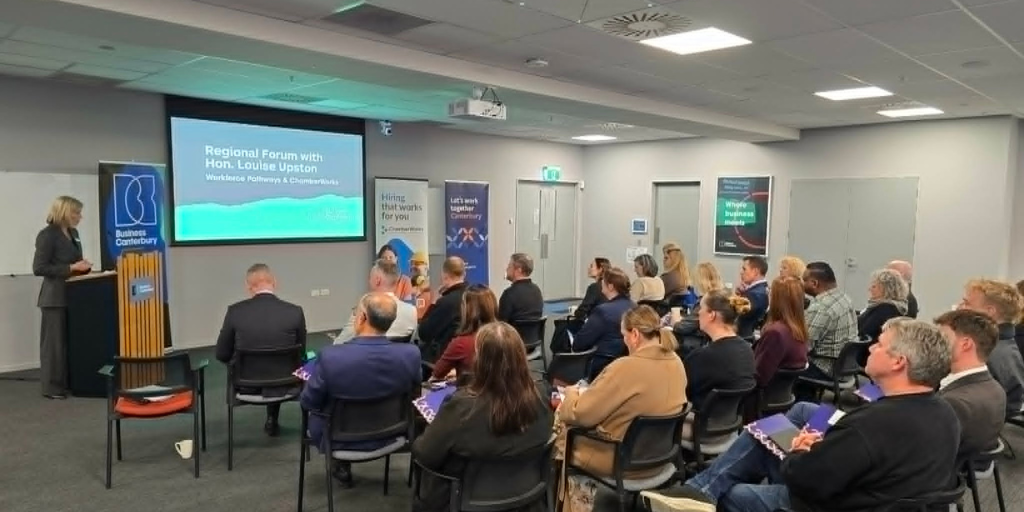
Business Canterbury is urging local employers to look again at the skills available among jobseekers, after hosting Social Development and Employment Minister Louise Upston and MSD Regional Commissioner Blair McKenzie for a Chamberworks discussion.
The chamber's 13 July update said the event focused on how Chamberworks can help Canterbury businesses connect with talent and build workforce capability. Chamberworks is delivered through New Zealand Chambers of Commerce in partnership with the Ministry of Social Development. Employers submit a vacancy, MSD identifies suitable candidates, and the chamber network helps make recruitment and support easier for businesses.
The local numbers are the reason the story matters. Business Canterbury reported that MSD supports nearly 38,000 degree-qualified clients nationally. In Canterbury, the jobseeker pool includes 5,800 people with hospitality, tourism and retail experience, 5,000 with transport, logistics and manufacturing experience, 2,900 with construction experience, and 3,400 with business support and contact-centre experience. The chamber also said about 40 percent of Canterbury jobseekers have been receiving a benefit for less than a year, and more than half of that group have experience in moderately to highly skilled roles.
That framing challenges a common assumption in hiring. Employers under pressure can treat the benefit system as separate from the skilled labour market, while jobseekers can find themselves filtered out before their experience is properly considered. Chamberworks is being presented as a way to reduce that gap by giving employers a clearer pathway to pre-screened candidates and support around onboarding, training and subsidies.
The programme was launched nationally earlier this year. In March, Upston said through the Beehive that Chamberworks was designed to support business owners with hiring decisions and help more New Zealanders into work. That national policy aim is now being translated into Canterbury-specific workforce conversations, with the chamber trying to show employers that the available talent pool is broader than many assume.
The event also put disability employment on the agenda. Business Canterbury said Upston, speaking as Minister for Disability Issues, highlighted that one in six New Zealanders are disabled and that almost three-quarters of disabled people not currently in employment want to work. The chamber update linked that point to the Government's 1 in 6 NZ initiative, which provides practical advice on workplace accessibility and inclusion.
For Canterbury businesses, the question is whether the programme feels practical enough to use. Recruitment support succeeds only when it reduces friction for employers without treating jobseekers as a generic list. A construction firm, retailer, manufacturer or contact centre needs candidates who can meet the role, understand the hours, get to the workplace and receive the right support early. The value of Chamberworks will depend on how well it handles those details.
The timing is important. Many local employers are cautious about costs, but still need reliable staff. Some sectors face skills shortages, while other experienced workers remain outside employment. If Chamberworks can shorten the distance between those two realities, it could help businesses fill vacancies and help jobseekers return to work before long-term disengagement becomes harder to reverse.
There is also a broader regional development point. Workforce capability is part of Canterbury's competitiveness. Transport, logistics, manufacturing, hospitality, tourism, construction and business support are all tied to the region's daily economy. Matching people into those roles is not only a social-policy goal. It affects service levels, project delivery, visitor experience, supply chains and household incomes.
Business Canterbury's message is therefore both practical and strategic: employers should not assume the talent they need is absent. Some of it may already be available, but sitting behind systems businesses do not usually use. Chamberworks will now need to prove it can turn that promise into placements that last.