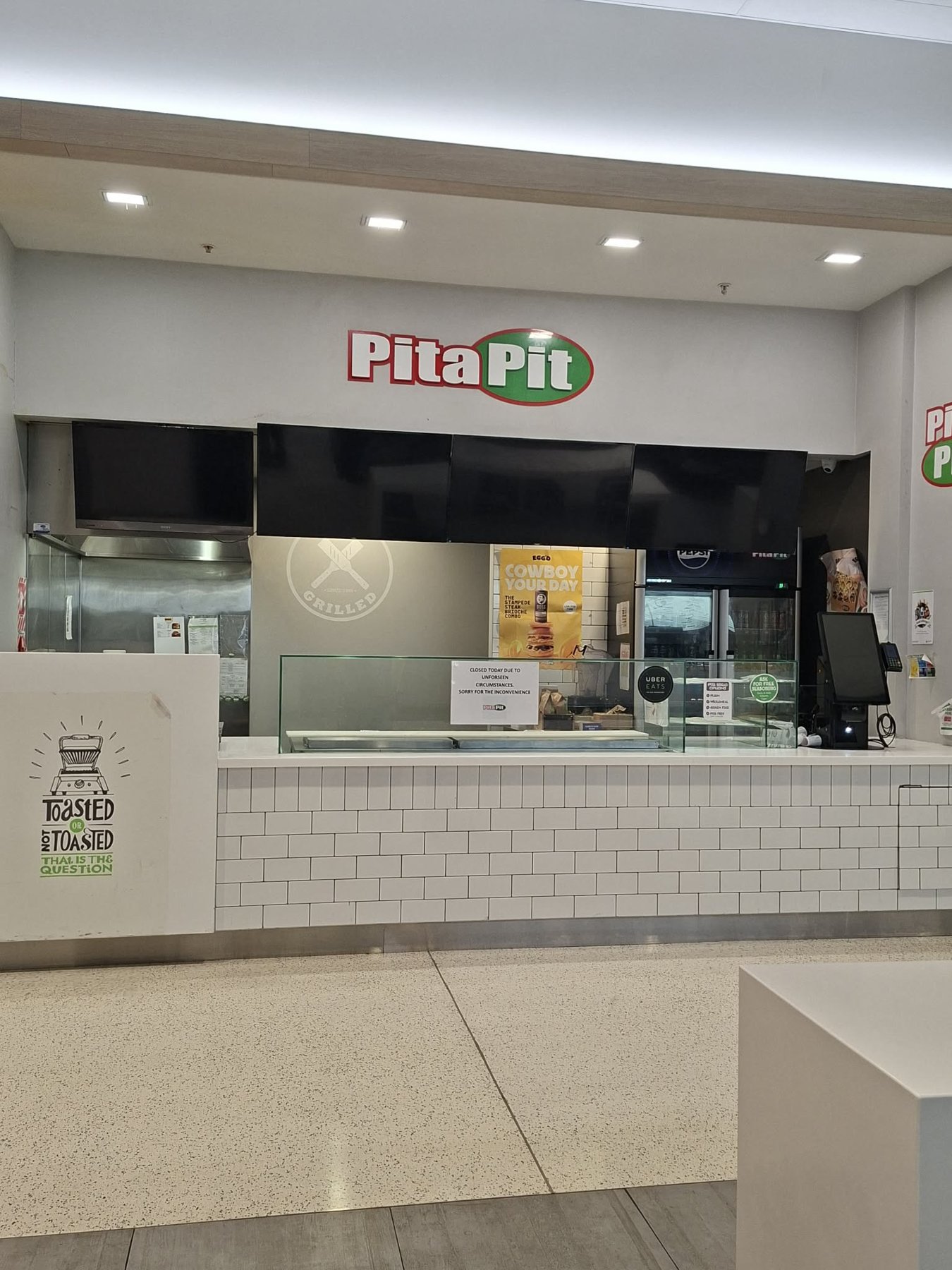
Pita Pit has closed two Christchurch mall outlets, pulling out of Hornby Hub and The Palms in Shirley while its South City and Sydenham stores continue to trade. The closures, reported on 25 June, are a small retail story on the surface but a useful signal of how mall food courts are continuing to change across the city.
At Hornby Hub, the reported sign on the outlet told customers the store was closed because of unforeseen circumstances. At The Palms, mall management confirmed the Pita Pit space had closed and said LJ’s Fish & Chips was expected to open in the food court within weeks. Hornby Hub confirmed the store had been closed for a few days, while Pita Pit’s Auckland office had not responded to the source report at the time of publication.
For customers, the practical detail is straightforward. Two mall branches are gone, while other Christchurch Pita Pit locations were operating as normal. The company’s store map still showed the Hornby Hub location but marked it closed for the day. That kind of lag is common when a chain changes its physical footprint faster than its digital listings, but it can frustrate customers who use online maps to choose lunch or dinner.
For mall owners, the closures show the constant churn inside food courts. A recognisable chain can leave, a seafood takeaway can move in, and the overall mix can change without a large public announcement. Food courts succeed when they balance familiar national brands, local operators, value options, quick service and enough variety to serve families, workers, students and older shoppers in the same space.
The Palms detail is especially worth watching because Shirley retail has been under close public scrutiny for years. Residents often judge a mall by its supermarket, anchor tenants and food choices as much as by fashion stores. Losing one chain outlet does not determine the future of a centre, particularly when a replacement tenant is already named, but repeated vacancies or weak food choices can shape public perception quickly.
Hornby’s situation is different. The southwest of Christchurch has strong population growth and a busy retail catchment, but that does not guarantee every food operator will work in every location. Labour costs, rent, franchise requirements, customer patterns and competition from nearby quick-service restaurants all affect whether a mall outlet remains viable.
No public evidence currently shows why Pita Pit closed the two stores, and it would be wrong to invent a financial explanation. The confirmed facts are narrower: the Hornby Hub and The Palms outlets have closed, The Palms has a replacement tenant expected, and other Christchurch Pita Pit stores remain open.
For Christchurch shoppers, the story is another reminder that food courts are not fixed infrastructure. They are active retail markets. The brands people expect to find in a mall can change quickly, and the centres that handle that change best are the ones that keep spaces filled, information current and food options useful for everyday visitors.
The next visible signs will be practical ones: whether the replacement tenant at The Palms opens on the expected timeline, whether Hornby Hub fills the space quickly, and whether Pita Pit updates its public store information.