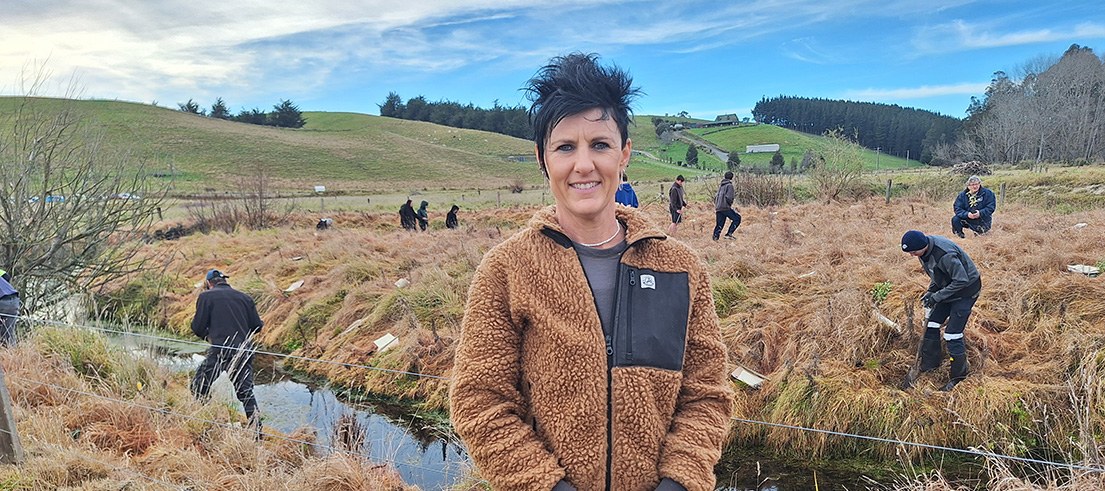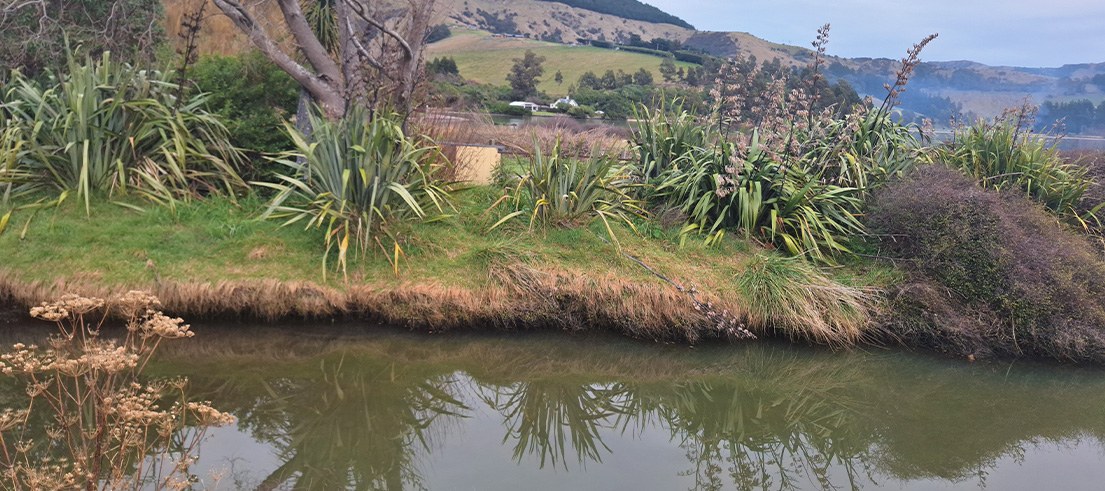
Native fish in Te Wharau Stream have survived one of Banks Peninsula's harshest recent flood tests, with new environmental DNA results giving restoration groups a stronger reason to keep investing in the catchment.
Environment Canterbury said on Thursday that biodiversity experts had feared heavy February rainfall may have wiped out or displaced many species in the stream, which flows through Te Ahu Patiki and Orton Bradley Park. The flood on 16 February damaged stream banks, created slips and pushed debris downstream. Because staff from Banks Peninsula Conservation Trust had taken environmental DNA samples at two sites on 20 January, shortly before the flood, scientists had a rare before-and-after comparison.
The second round of testing, taken on 19 March, showed many species were still present. ECan said nine native fish species were detected before the flood and eight were detected after it. That does not mean every fish stayed in exactly the same place. Some may have found refuge, some may have moved upstream and others may have recolonised parts of the stream once flows dropped. But the result is still important because it shows the waterway retained much of its ecological life after a severe disturbance.
Environmental DNA, often called eDNA, works by detecting genetic material shed by organisms into water, soil or other surroundings. It is useful because researchers do not always have to catch or see each species directly. In a small stream after a flood, that can be a major advantage. It lets ecologists check whether fish, invertebrates and other organisms are likely to be present without relying only on visual surveys.
The findings also point to wider stream health. ECan said post-flood analysis still detected a good range of macroinvertebrates, including mayfly and caddisfly. Those small aquatic animals are important food for fish and are often used as indicators of water quality. Their presence suggests the stream has retained ecological function despite sediment, bank damage and debris movement.
There was one unusual result: DNA from a hairy-handed crab was detected well upstream. ECan noted that the crab is not adapted to freshwater, making its appearance in the test a puzzle. One possible explanation raised in the council story is that a bird may have carried crab remains into the catchment. That detail matters because it shows both the promise and the limits of eDNA. The science can reveal hidden signals, but interpretation still needs local ecological judgement.
The next stage is practical restoration. The Whaka-Ora Healthy Harbour programme has approved $46,000 for a Te Wharau fish passage project to remove a collapsed ford and replace it with a prefabricated slab bridge. That should make it easier for fish to move through the stream. Co-governors have also approved a $115,000 three-year project with Orton Bradley Park and landowners to convert a bull paddock near the park entrance into a coastal wetland.
For Banks Peninsula, the result is encouraging because flood recovery is often discussed only in terms of damage. Te Wharau Stream shows another side of the story. The flood was destructive, but enough native life remained to make restoration work meaningful. If fish passage, planting and wetland work are delivered well, the stream could come out of the event with stronger long-term habitat than before.