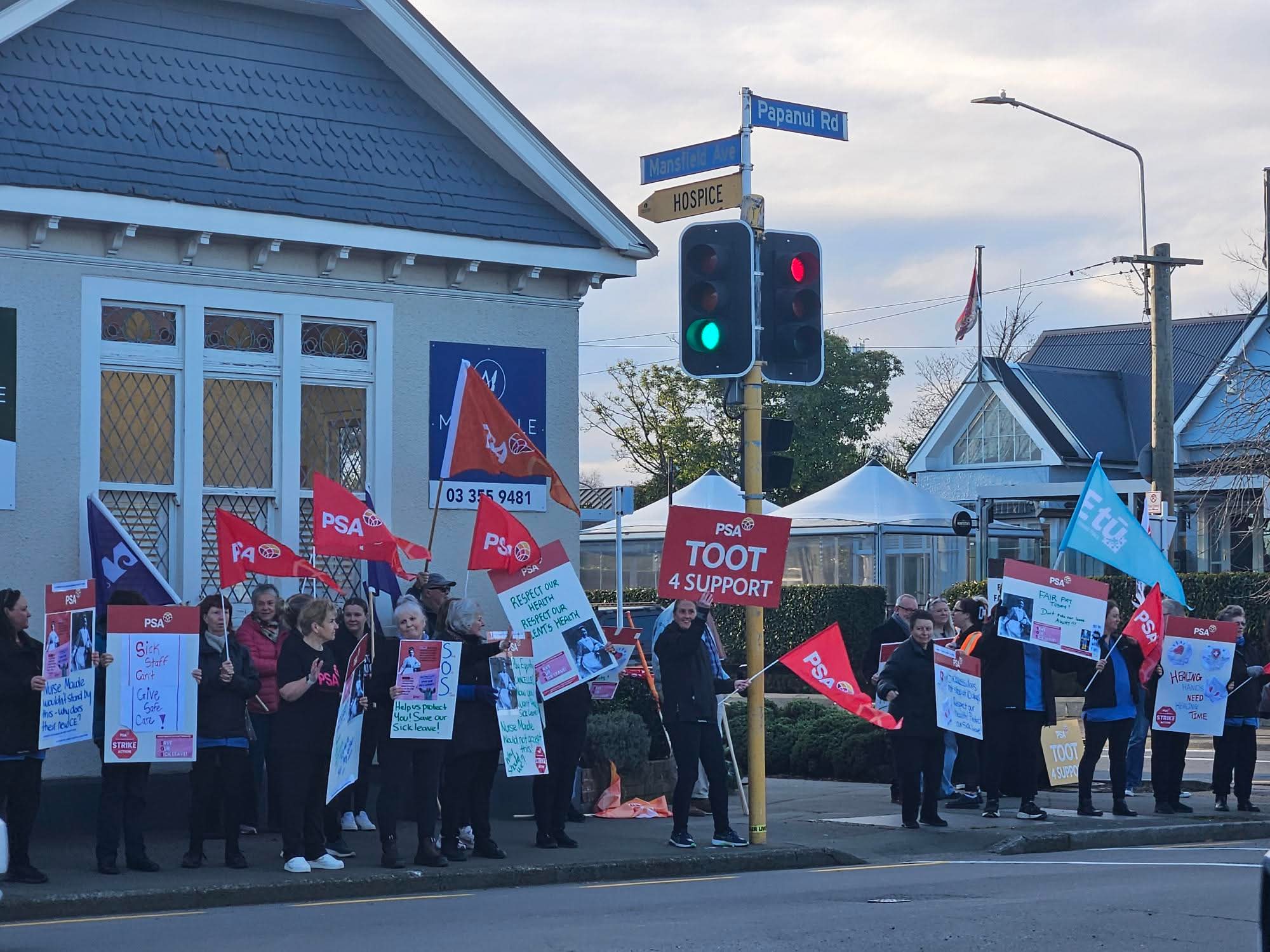
Nurse Maude care and support workers took strike action in Christchurch on Friday morning as a pay and sick-leave dispute widened across several centres.
Chris Lynch Media reported that workers picketed in Christchurch, Rangiora and Lincoln during a stop-work action from 7am to 10am on Friday 31 July. The Public Service Association said more than 250 workers nationwide were involved. The union accused Nurse Maude of withdrawing a pay offer and seeking to remove two sick leave days from existing conditions.
The sick-leave issue is central to the dispute because care and support work is physically and emotionally demanding, and because workers move between homes and vulnerable clients. The PSA said workers currently have 12 sick leave days, two above the statutory minimum of 10. A reduction may look small on paper, but for workers who are exposed to illness, travel between clients and often have modest incomes, two days can be a meaningful buffer.
Nurse Maude chief executive Louise Zacest told Chris Lynch Media the organisation respected workers' right to industrial action and said the focus remained on client care and safety. The provider said its bargaining team was negotiating in good faith and hoped for a fair settlement. That response underlines the tension in the dispute: both continuity of care and fair employment conditions matter, and neither side can ignore the people receiving support at home.
The strike has particular weight in Christchurch because Nurse Maude is one of the city's best-known community health and support organisations. Its staff work with people who may be elderly, disabled, recovering from illness or managing long-term conditions. When those workers take industrial action, the public effect is not as visible as a bus strike or a supermarket closure, but it can be deeply felt by clients who rely on regular visits.
The dispute also reflects a broader care-sector problem. New Zealand depends heavily on support workers to keep people well and independent outside hospital settings. That work can prevent unnecessary admissions, reduce pressure on emergency departments and allow families to keep caring arrangements stable. Yet the sector often struggles with pay, recruitment, burnout and the challenge of funding services that are essential but not always publicly visible.
For workers, the issue is not only hourly pay. Conditions such as sick leave, travel time, predictable rosters, training and safety processes shape whether people can stay in the job. If experienced support workers leave, providers may find themselves filling gaps with less experienced staff or reducing continuity for clients. That can create a cycle where workers feel less supported and clients see more turnover.
The PSA has signalled further action, with a second strike planned for 10 August across Christchurch, Rangiora, Lincoln, Nelson, Motueka, Blenheim, Wellington, Lower Hutt, Upper Hutt, Porirua and Kapiti if the dispute remains unresolved. That gives both parties a short window to keep negotiating before disruption expands.
For the public, the most useful way to read the strike is as a care-system warning. Home and community support depends on workers whose labour is often quiet, mobile and under-recognised. A dispute over two sick days and a pay offer may seem procedural, but it is really about whether the workforce can stay healthy enough, and stable enough, to keep caring for others.