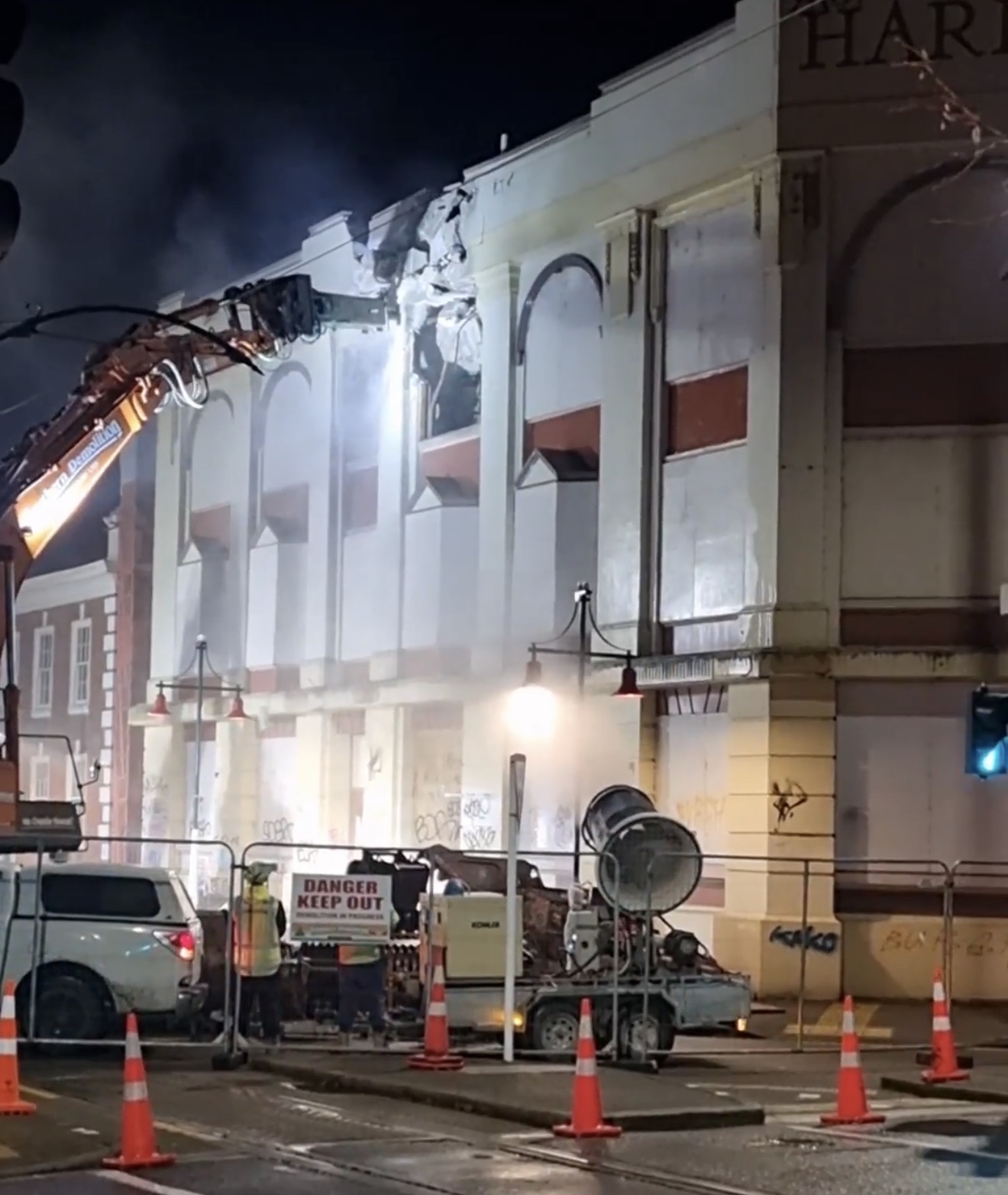
The overnight demolition of Harley Chambers has removed one of central Christchurch's most recognisable damaged heritage buildings and reopened the argument over what the city gains and loses when earthquake-era sites finally change.
Chris Lynch Media reported on Sunday that demolition of the building on the corner of Cambridge Terrace and Worcester Boulevard began on Saturday night. Harley Chambers, also known as Harley Buildings, had stood for almost a century. It was built in 1929 and extended in 1934 as professional rooms for doctors and dentists.
Heritage New Zealand's listing describes the building as socially and historically significant because of that original medical and dental purpose. It also records architectural value as work associated with Christchurch architect G T Lucas, and technological value for heating, ventilation and electrical systems considered innovative at the time. In short, this was not only an old facade. It was part of the professional, architectural and technical history of pre-earthquake Christchurch.
The problem was its post-earthquake condition. Harley Chambers was badly damaged during the Canterbury earthquakes and remained vacant while its state deteriorated. By 2024, Cambridge 137 Limited had applied for consent to demolish the building and construct a 42 metre hotel on the site. Christchurch City Council's consultation material described the proposal as an 11-floor, 200-room hotel.
Chris Lynch Media reported that an independent commissioner approved the resource consent in December 2024. The approved proposal includes hotel rooms, a restaurant, reception area, fitness centre and vehicle loading area. It was later placed on the market as the owners sought a purchaser, lessee or hotel management agreement.
For central-city watchers, Harley Chambers is a familiar kind of Christchurch story. The city wants active sites, more visitors, more residents and more evening life. It also wants to hold on to the built history that gives the central city texture and memory. Buildings that have sat empty and damaged for years make that balance harder. They can become safety, cost and opportunity problems while still holding real heritage value.
The demolition also lands at a time when hotel and visitor accommodation projects are being read as signals of central-city confidence. A completed hotel on Cambridge Terrace would add beds near the Arts Centre, river precinct, convention centre, hospitality areas and the wider central business district. If it proceeds, it would turn a long-vacant corner into a commercial site with daily foot traffic.
But demolition is irreversible. Once a Category 2 heritage building is gone, the debate shifts from whether it could have been saved to whether the replacement earns its place. Christchurch has enough examples of weak post-demolition outcomes to know that consented development and actual city benefit are not the same thing.
The next test is therefore not only construction. It is design quality, street-level use and delivery. If the hotel proceeds, residents will judge whether the corner contributes to Cambridge Terrace and Worcester Boulevard or simply fills a gap. If it stalls, the city risks another cleared site waiting for market certainty.
Harley Chambers' removal closes one chapter of the earthquake rebuild. It does not close the wider question of how Christchurch treats damaged heritage when the building is loved, the repair case is hard and the development pressure is real.