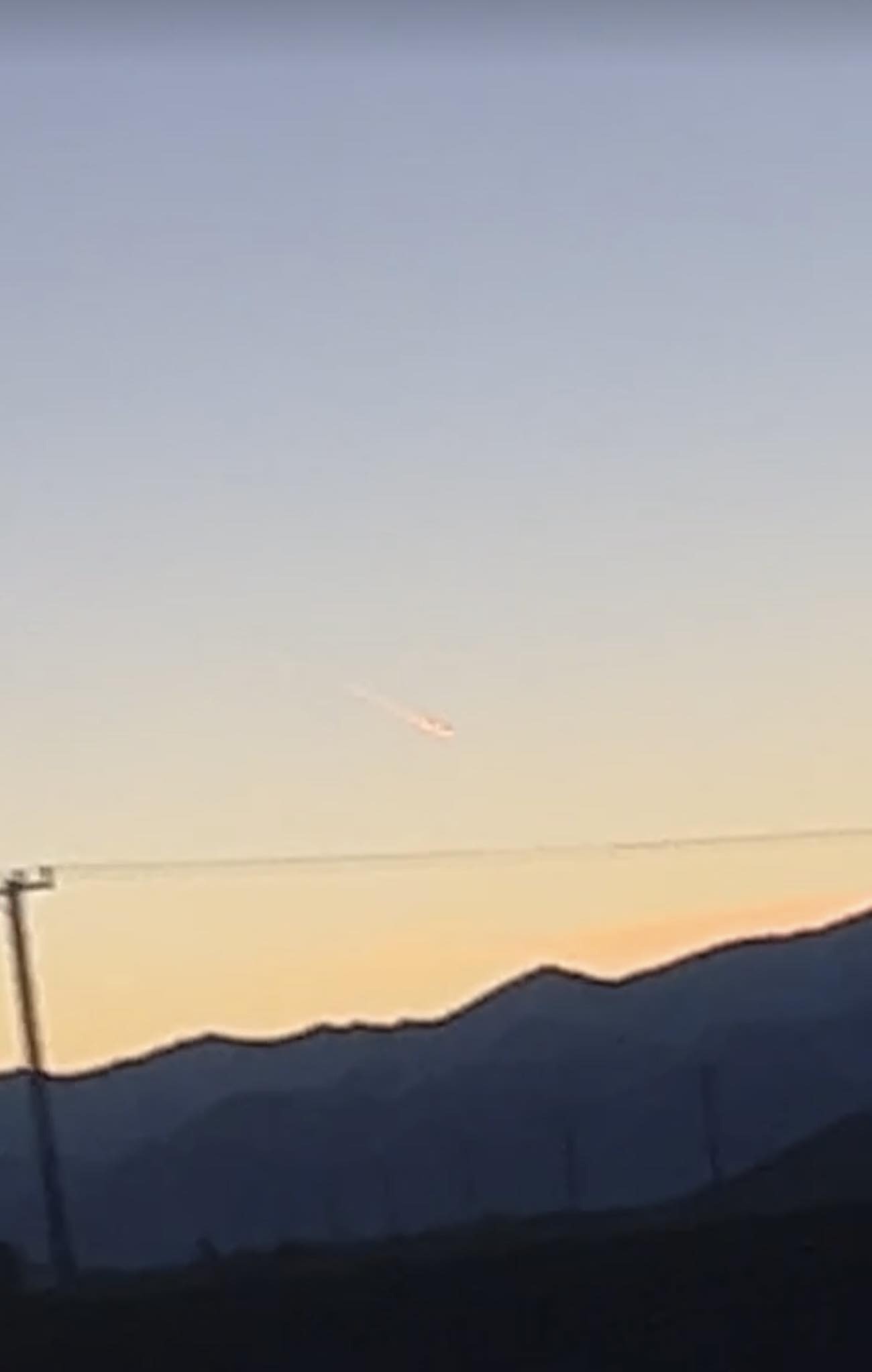
A bright object reported over Canterbury on Sunday evening has been identified as a meteor, after residents across the region photographed unusual streaks in the sky and sent reports to local media.
Chris Lynch Media reported that people contacted the site after seeing a bright orange object moving across the evening sky. One image captured over the Port Hills showed a concentrated bright object with an orange trail. Steve Wyn Harris, a citizen scientist with Fireballs Aotearoa, identified that object as a meteor.
The same report also made an important distinction. A separate photograph taken while looking west showed a longer, wavy orange streak. Wyn Harris said that image was a contrail, not the meteor. That matters because sky events often generate several different photos and descriptions within minutes. Without careful identification, a meteor, aircraft trail and cloud-lit sunset feature can quickly be treated as the same thing.
The confirmed detail is limited but clear. The Port Hills image was identified as a meteor. A different wavy orange streak was identified as a contrail. Chris Lynch Media said dozens of people contacted the outlet after the evening sighting. A Christchurch resident quoted in the report described seeing what looked like a low shooting star with a bright green tail and orange ball.
Fireballs Aotearoa gives the event a wider scientific context. The organisation describes itself as the public face of New Zealand's citizen science meteor camera network, with cameras hosted by schools, observatories and members of the public. Its purpose is to help identify meteor paths, support meteorite recovery where possible and involve the public in night-sky observation.
That citizen-science role is useful in Canterbury because eyewitness accounts can be vivid but imprecise. A person standing in Christchurch, Banks Peninsula, North Canterbury or Mid Canterbury may see the same object from a different angle. The object may seem close even when it is high in the atmosphere. Colour, brightness and direction can also be affected by cloud, light, camera exposure and local geography.
The safe interpretation for now is therefore modest. There is no confirmed public evidence in the source material that a meteorite landed, that an impact occurred or that emergency services were involved. The story is about a visible meteor sighting and the process of sorting it from a separate contrail.
For residents, the event is still notable. Winter evenings often bring clear, cold skies, and a bright meteor can be dramatic enough to stop people outdoors, prompt calls and fill neighbourhood social feeds. It also gives schools and families a useful way into basic astronomy: a meteor is the visible streak produced when a small piece of space material enters Earth's atmosphere and heats up.
The next step, if more evidence emerges, would usually be camera triangulation or further public reports. Fireballs Aotearoa and similar networks depend on multiple observations to assess direction and possible fall zones. Until then, Sunday's sighting should be treated as a verified local sky event rather than a cause for alarm.
The practical advice for anyone who photographed the object is straightforward: keep the original image or video file, note the exact time and location as accurately as possible, and avoid altering the file before sharing it with a credible astronomy or meteor-tracking group. Original timestamps, camera direction and location details are often more useful than a compressed social-media repost. Even when a sighting does not lead to a meteorite search, those records can help scientists understand how visible events were seen from different parts of the country.